
Home » What Are Plastic Resins for Bottle Caps and Closures?
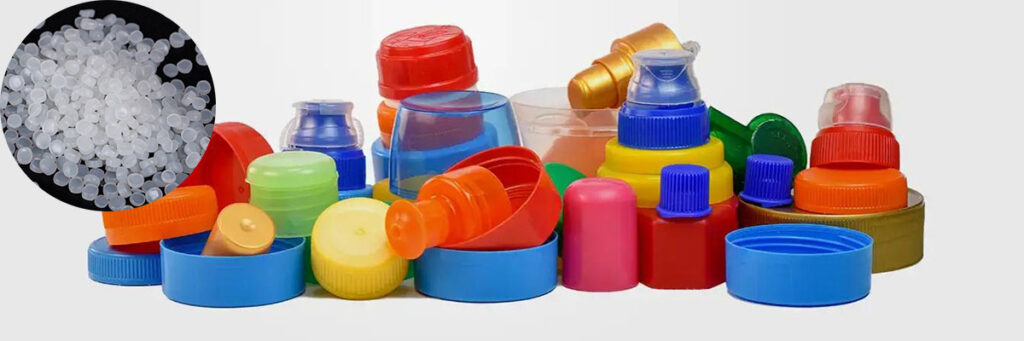
Plastic resins for bottle caps and closures are pecifically selected for their ability to meet the functional needs of bottle caps and closures, such as sealing, durability, safety, and processability. These polymers, mainly thermoplastics, can be melted and remolded, making them ideal for mass production of bottle caps through processes like injection molding. The most widely used polymers for bottle caps are polyolefins, including PP, HDPE, and LDPE. These core polymers stand out for their non-toxicity, chemical resistance, and adaptability to different application scenarios. Meanwhile, these polymers ensure that bottle caps effectively protect the contents, maintain product freshness, and meet industry safety standards across food, beverage, daily chemical, and pharmaceutical sectors.
Would Like The Quotation
Leave more about your requirements, such as, brands, models, quantity, package, country, etc.
Key Plastic Resins for Bottle Caps and Closures: PP, HDPE, LDPE
Plastic resins for bottle caps and closures need to meet the core requirements of good sealing, safety and non-toxicity, easy processing, and cost-effectiveness. PP, HDPE, and LDPE have become the first choice of manufacturers due to their excellent comprehensive performance and high cost performance. They have different characteristics and are suitable for different types of plastic caps.
Polypropylene PP: The Most Versatile Resin for Plastic Caps
Polypropylene PP: The most versatile resin for plastic caps
PP is the most widely used resin in the plastic cap industry. Its unique properties make it suitable for a variety of harsh application scenarios, especially in the food and beverage industry with high safety and performance requirements.
Excellent performances of PP resin used in plastic caps
PP resin has the advantages of high temperature resistance (heat resistance up to 100–120℃, even up to 130℃ for some modified PP), good rigidity, strong chemical stability, and excellent impact resistance.
It is non-toxic, odorless, and meets the food-grade safety standards, making it safe for direct contact with food and beverages.
In addition, PP has a low density (0.90-0.91 g/cm³), which is one of the lightest common plastics, helping to reduce the material consumption and transportation cost of a single cap.
It also has good processability and can be processed by injection molding, compression molding, and other methods, and can be made into transparent products through rapid cooling processing, which is suitable for the production of various types of caps.
What are main applications scenarios of PP in Plastic Caps?
- Carbonated beverage caps. PP resin has good pressure resistance and can withstand the internal pressure of carbonated beverages, preventing the cap from deforming or leaking. At the same time, its chemical stability is strong, and it will not react with the acidic substances in carbonated beverages, ensuring the safety and taste of the beverage.
- Hot-fill beverage caps. For hot-fill products such as tea, juice, and soy milk, PP’s high temperature resistance plays a key role. It can maintain its shape and sealing performance under high temperature conditions, avoiding the problem of cap deformation and leakage caused by high temperature.
- Condiment and jam caps. PP resin has good resistance to acids, alkalis, and oils, and will not be corroded by these substances, ensuring the sealing and durability of the cap. It is also suitable for the production of flip-top caps for condiment bottles due to its good hinge performance.
- Anti-theft caps. PP resin has good toughness and impact resistance, which is easy to process into anti-theft structures. When the cap is opened, the anti-theft ring can be smoothly broken, ensuring the anti-counterfeiting and safety of the product.
Would Like The Quotation
Leave more about your requirements, such as, brands, models, quantity, package, country, etc.
High-Density Polyethylene HDPE: The Preferred Resin for Cold-Fill and Daily Chemical Caps
Core properties of HDPE resin used in plastic caps and closures
- HDPE resin has good low-temperature resistance, can maintain good toughness even at -40℃, and is not easy to break.
- It has strong resistance to stress cracking, good chemical stability, and can resist the erosion of most chemicals.
- It is non-toxic and odorless, meets food-grade and daily chemical-grade safety standards, and has good processability, low production cost.
- Its heat resistance is moderate, and it can withstand a temperature of about 100℃, but it is not suitable for long-term use in high-temperature environments.
What are application scenarios of HDPE in plastic caps?
- Drinking water and cold-fill beverage caps. Mineral water, purified water, and cold-fill fruit juicedon’trequire high temperature resistance of the cap. HDPE’s good low-temperature toughness and sealing performance can effectively prevent water leakage and ensure the freshness of the product. Many 38mm aseptic plastic caps for non-carbonated beverages are made of HDPE.
- Milk and dairy product caps.Milk, yogurt, and other dairy products are usually stored at low temperatures. HDPE’s low-temperature resistance can ensure that the cap will not become brittle and break during low-temperature storage. At the same time, its non-toxic and odorless characteristics can avoid affecting the taste of dairy products. It is also suitable for the production of milk bucket caps due to its good rigidity.
- Daily chemical product caps.HDPE has strong chemical stability and will not react with the active ingredients in daily chemicals. It is suitable for making flip-top caps, pump caps, and screw caps of daily chemical products.
- Pharmaceutical caps.For some oral liquid bottles and syrup bottles that do not require high temperature sterilization, HDPE caps are a good choice. Their non-toxicity and good sealing performance can ensure the stability of the medicine and prevent moisture and pollution.
Would Like The Quotation
Leave more about your requirements, such as, brands, models, quantity, package, country, etc.
Low-Density Polyethylene LDPE: The Core Resin for Cap Liners and Gaskets
Core properties of LDPE resin used in plastic caps
It can closely fit the bottle mouth to prevent liquid leakage and air leakage.
It has good chemical stability, non-toxic and odorless, and meets food-grade and daily chemical-grade safety standards.
Its heat resistance is relatively poor, so it is not suitable for high-temperature scenarios.
LDPE is the lightest variety in polyethylene resins, with good transparency and easy processing, and is often used in the production of thin-walled products such as films and gaskets.
What are Application Scenarios of LDPE in Plastic Caps?
- Cap liners. The liner inside the plastic caps made of LDPEcan fill the gap between the cap and the bottle mouth, improve the sealing performance, and prevent liquid leakage and air entry, thus extending the shelf life of the product. The LDPE cap liner has good flexibility and can adapt to the slight deformation of the bottle mouth, ensuring the sealing effect.
- Gaskets and sealing rings. For caps that require high sealing performance, LDPE gaskets or sealing rings are usually added. They can play a role in shock absorption and sealing, avoiding leakage caused by vibration during transportation. LDPE’s good flexibility also makes the gasket easy to install and replace.
- Soft caps. LDPE is used to make soft caps for some special products, such as oral liquid caps, eye drops caps, and small-dose cosmetic caps. These caps need to be soft and easy to squeeze or open, and LDPE’s flexibility can meet this demand. It is also used in some squeeze-type bottle caps (such as ketchup bottle caps) due to its good ductility.
Would Like The Quotation
Leave more about your requirements, such as, brands, models, quantity, package, country, etc.
FAQs of Plastic Resins for Bottle Caps and Closures
1. Which resin is the safest for food and beverage plastic caps?
PP and HDPE are the safest resins for food and beverage plastic caps. Both are non-toxic, odorless, meet the food-grade safety standards of FDA and EU, and will not release harmful substances when in contact with food and beverages. They have good chemical stability and will not react with acidic, alkaline, or oily substances in food, ensuring food safety. Among them, PP is more suitable for hot-fill products, and HDPE is more suitable for cold-fill products. LDPE is also safe and is mainly used as a liner material.
2. Which resin can be used for hot-fill beverage bottle caps?
PP is the preferred resin for hot-fill beverage caps. PP resin has good high temperature resistance can maintain its shape and sealing performance under the hot-fill temperature (85–95℃) of tea, juice, and other beverages. However, it should be noted that ordinary PP has poor low-temperature toughness, select copolymer PP if it needs to be used in low-temperature environments.
3. Why is LDPE not used alone to make hard plastic caps?
LDPE resin is soft and easy to deform. If it is used alone to make hard plastic caps, it cannot maintain the shape of the cap, and it is easy to break or deform during transportation and use. Therefore, LDPE is mainly used as a liner, gasket, or soft cap material, and relies on its good flexibility and sealing performance to cooperate with PP or HDPE hard caps to improve the overall performance of the cap.
4. How to choose the right resin for drinking bottle caps?
Hot-fill bottle caps and closure choose PP.
Cold-fill bottle caps and closure choose HDPE.
Caps that need high sealing performance add LDPE liner.
5. Are plastic caps made of PP, HDPE, and LDPE recyclable?
Yes. PP, HDPE, and LDPE are all recyclable plastics. Their recycling marks are No. 5 (PP), No. 2 (HDPE), and No. 4 (LDPE) respectively.