
Home » SNF vs PCE: Which superplasticizer is better
Superplasticizers, also known as high-range water reducers, are essential chemical admixtures that transform concrete performance in the construction industry. They improve workability, boost strength, enhance durability, and reduce water consumption, all while keeping construction costs in check. Among the most widely used superplasticizers worldwide, Sodium Naphthalene Sulfonate (SNF) and Polycarboxylate Ether (PCE) stand out as the two dominant options. But SNF vs PCE, which superplasticizer is better for your specific project?
This comprehensive guide compares SNF and PCE superplasticizers in detail, covering their chemical compositions, working mechanisms, key performance metrics, application scenarios, cost-effectiveness, and environmental impacts.
Would Like The Quotation
Leave more about your requirements, such as, brands, models, quantity, package, country, etc.
What Is SNF Superplasticizer?
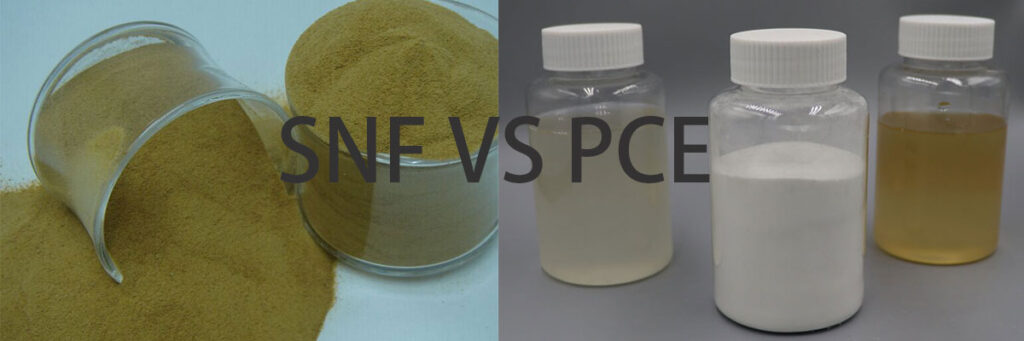
SNF is a traditional, second-generation superplasticizer that has been a staple in construction for decades. Commercially, SNF is available as a yellowish to dark brown powder or a liquid solution with a concentration of 40–50%. Known for its affordability and reliable basic performance, SNF is widely used in general-purpose concrete projects where high performance is not a primary requirement. Its simplicity and cost-effectiveness make it a popular choice for low-budget projects worldwide.
What Is PCE Superplasticizer?
PCE is a modern, high-performance superplasticizer belonging to the third and fourth generations of concrete admixtures. It features a unique comb-like molecular structure, with a polycarboxylic acid main chain and polyether side chains. It has a molecular weight ranging from 20,000 to 50,000 daltons, significantly higher than SNF’s 1,000–10,000 daltons.
PCE is celebrated for its superior water reduction, excellent slump retention, and customizable properties. Its molecular structure can be tailored to meet specific project needs, making it ideal for high-performance concrete applications such as super high-rises, precast components, and green building projects.
Would Like The Quotation
Leave more about your requirements, such as, brands, models, quantity, package, country, etc.
SNF VS PCE: Key Performance Comparison
1. Working Mechanism
SNF: Relies solely on electrostatic repulsion to disperse cement particles. SNF molecules adsorb onto the surface of cement particles, imparting a negative charge via their sulfonate groups. This charge causes the particles to repel each other, preventing flocculation. However, its short, rigid molecular structure provides limited steric hindrance, making it less effective for long-term dispersion, especially in high-temperature environments.
PCE: Utilizes a dual mechanism of electrostatic repulsion and steric hindrance. The carboxylate groups on the main chain adsorb to cement particles, providing initial repulsion, while the long polyether side chains form a physical barrier around the particles, preventing agglomeration more effectively than SNF. Some PCE superplasticizer also have sustained-release properties, continuously releasing active ingredients to maintain workability over time.
2. Water Reduction Rate
Water reduction rate is the most critical indicator of superplasticizer performance, as it directly impacts concrete strength and durability. A higher water reduction rate allows for a lower water-cement ratio, resulting in denser, stronger concrete.
SNF: Typically achieves a water reduction rate of 15–25%, with high-quality products reaching up to 30%. To achieve higher water reduction, a higher dosage is required, which can increase costs and lead to side effects like bleeding or segregation.
PCE: Offers a significantly higher water reduction rate of 20–40%, with high-performance variants exceeding 35%. For example, under the same water-cement ratio, adding 0.8% PCE can achieve a 28% water reduction rate, while adding 1.2% SNF only achieves 18%. This superior performance makes PCE the top choice for high-strength concrete.
3. Slump Retention
Slump retention refers to a superplasticizer’s ability to maintain concrete fluidity over time, which is critical for long-distance transportation, large-scale construction, and high-temperature environments.
SNF has poor slump retention. Concrete mixed with SNF often experiences a 30–50% slump loss within 2 hours under normal conditions. In high temperatures, slump loss can be even more severe, with slump dropping from 150mm to 1mm within 2 hours, requiring additional retarders like sodium gluconate to meet construction needs.
PCE has excellent slump retention. PCE concrete typically has a slump loss of less than 10% within 2 hours, making it ideal for ready-mix concrete, long-distance transportation, and high-temperature construction. Some modified PCE superplasticizers can maintain workability for 120–180 minutes, eliminating the need for additional retarders in most cases.
4. Concrete Strength
Lower water-cement ratios lead to higher compressive strength and better long-term durability.
SNF provides good early strength but lower long-term strength. For example, SNF concrete with an 18% water reduction rate has a 28-day compressive strength of 65.3 MPa—suitable for projects with moderate strength requirements(C30 and below).
PCE delivers high early and long-term strength. PCE concrete with a 28% water reduction rate can reach a 28-day compressive strength of 72.5 MPa, making it ideal for high-strength concrete (C50 and above), precast components, and infrastructure projects that require long-term durability.
5. Compatibility with Cement and Aggregates
SNF: Poor compatibility with high-C3A content cement and high-alkali cement. It may require a 30% higher dosage to achieve the same effect with high-C3A cement and is prone to rapid setting with high-alkali cement. SNF also fails when aggregate mud content exceeds 3%.
PCE: Better compatibility with various cement types, including high-C3A, high-alkali, and fly ash-blended cement. While ordinary PCE may be sensitive to clay minerals like montmorillonite, specialized anti-mud PCEs can function effectively even when aggregate mud content exceeds 3%.
6. Cost-Effectiveness
PCE is typically 30–50% more expensive than SNF due to its superior performance, but it allows for lower dosage rates. PCE reduces cement usage by 15–25% and lowers pumping energy consumption by 40%, leading to long-term cost savings.
7. Environmental Impact
SNF is less environmentally friendly. SNF production involves formaldehyde, a toxic substance that can be released into the environment if not properly controlled. It also has a higher carbon footprint due to its lower efficiency and higher dosage requirements.
PCE is more environmentally friendly. PCE production does not involve formaldehyde, and its lower dosage and ability to reduce cement usage make it a greener choice. PCE aligns with global green building standards and carbon reduction goals, making it ideal for sustainable construction projects.
8. Application Scenarios
SNF: Ideal for low-cost, general-purpose projects, including:
1. Residential buildings with low strength requirements (C30 and below).
2. Roads, sidewalks, and non-critical infrastructure.
3. Short-duration projects with no long-distance transportation needs.
4. Projects with tight budget constraints.
PCE: Suitable for high-performance, demanding projects, including:
1. High-strength concrete (C50 and above) and self-compacting concrete (SCC).
2. Super high-rise buildings and long-distance pumping projects (over 100 meters).
3. Precast components (can reduce demolding time by 50%).
4. Marine and underground structures (reduces chloride diffusion by 50%).
5. 3D printing concrete and emerging construction technologies.
6. Green building projects requiring low carbon emissions.
Would Like The Quotation
Leave more about your requirements, such as, brands, models, quantity, package, country, etc.
FAQs about SNF vs PCE
1. What is the main difference between SNF and PCE superplasticizers?
The main difference lies in their molecular structure and working mechanism. SNF has a short, rigid molecular structure and relies solely on electrostatic repulsion to disperse cement particles. PCE has a comb-like structure and uses both electrostatic repulsion and steric hindrance, resulting in superior water reduction, slump retention, and overall performance.
2. Which superplasticizer has a higher water reduction rate: SNF or PCE?
PCE has a significantly higher water reduction rate (20–40%) compared to SNF (15–25%). High-performance PCE superplasticizers can exceed 35% water reduction, while SNF rarely exceeds 30% even at higher dosages.
3. Can SNF be used for high-strength concrete (C50+)?
It is not recommended. SNF’s maximum water reduction rate (up to 30%) is insufficient to achieve the low water-cement ratio required for C50+ concrete. The superior water reduction (20–40%) of PCE makes it the only suitable choice for high-strength concrete projects.
4. Which superplasticizer is better for long-distance concrete transportation?
PCE is better. It has excellent slump retention, with a slump loss of less than 10% within 2 hours, ensuring concrete remains workable during long-distance transport. SNF has poor slump retention, with significant loss within 1–2 hours, making it unsuitable unless combined with retarders.
5. Is PCE compatible with all types of cement?
PCE has better compatibility with most cement types, including high-C3A, high-alkali, and fly ash-blended cement. While ordinary PCE may be sensitive to clay minerals, specialized anti-mud PCE can overcome this issue. SNF has poor compatibility with high-C3A and high-alkali cement and fails with high-mud-content aggregates.
6. Does SNF cause environmental pollution?
SNF production involves formaldehyde, a toxic substance that can be released into the environment if not properly controlled. It also has a higher carbon footprint due to its lower efficiency and higher dosage. PCE is more environmentally friendly, with no formaldehyde in its production and lower CO₂ emissions.
7. Can I mix SNF and PCE superplasticizers?
It is not recommended to mix SNF and PCE directly. Their molecular structures and working mechanisms are incompatible, which can lead to reduced performance or concrete defects like bleeding and segregation. If switching between the two, clean mixing equipment thoroughly first.
8. Which superplasticizer is better for precast concrete?
PCE is better for precast concrete. It shortens demolding time by 50% due to its high early strength, improving production efficiency. SNF requires additional early-strength admixtures to achieve similar results, increasing costs and complexity.
9. Which superplasticizer is more suitable for marine environments?
PCE is more suitable for marine environments. It reduces the chloride diffusion coefficient by 50%, enhancing concrete’s corrosion resistance and durability. SNF requires additional anti-rust admixtures to achieve similar results, increasing project costs.