
Home » Pipe Grade Resins: PVC vs PE80 vs PE100 vs PPR
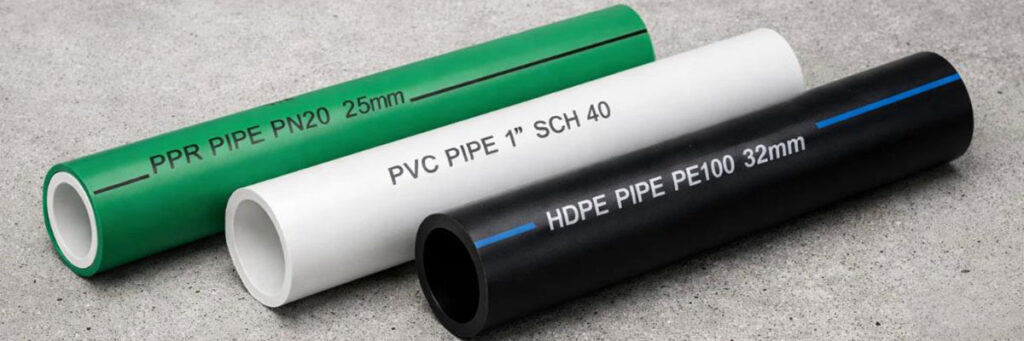
In the plastic pipe manufacturing industry, the choice of plastic resin raw material directly determines the pipe’s performance, application scenarios, service life, and cost control. As a professional supplier of pipe grade plastic resins, we provide stable supply of four core resins, PVC, PPR, PE100, and PE80. These four polymers can cover all application needs such as municipal water supply and drainage, building pipelines, agricultural irrigation, and industrial transportation.
Would Like The Quotation
Leave more about your requirements, such as, brands, models, quantity, package, country, etc.
PVC Resin: Cost-Effective General-Purpose Pipe Material
Polyvinyl Chloride PVC is one of the most widely used resins in the plastic pipe industry. It is divided into rigid polyvinyl chloride (UPVC) and flexible polyvinyl chloride (SPVC). Among them, UPVC is the mainstream choice for pipe production due to its high rigidity and low cost. PVC resin has an amorphous structure with a density of approximately 1.3-1.4g/cm³. It boasts excellent processability and can be quickly formed through extrusion, injection molding, and other processes, making it suitable for large-scale production of various pipes.
Core Characteristics of PVC Resin for Pipes
Low cost. PVC resin has obvious price advantages compared to PP and PE series resins.
High rigidity and good compression resistance, able to withstand a certain pressure at room temperature.
Excellent corrosion resistance. It is capable of resisting erosion by most inorganic acids, alkalis, and salt solutions, without rusting or scaling.
Limitations:
It has the disadvantage of low-temperature brittleness, prone to brittle fracture when the temperature is below 0℃, and poor impact resistance.
Some models contain plasticizers, making them unsuitable for drinking water transportation.
General aging resistance, prone to aging and degradation when laid outdoors for a long time.
Common Applications of PVC pipe grade
Municipal sewage pipes, rainwater pipes, building drainage pipes, wire and cable sleeves, agricultural irrigation pipes, etc.
Would Like The Quotation
Leave more about your requirements, such as, brands, models, quantity, package, country, etc.
Polypropylene PPR Resin: For both hot and cold water pipes
Random copolymer polypropylene PPR is the preferred raw material for building hot and cold water pipes due to its balanced rigidity and flexibility. With a density of approximately 0.90-0.91g/cm³, PP resin is the lightest among the four resins, facilitating transportation and processing.
Core Characteristics of PPR for Pipes
Excellent temperature resistance. It has a long-term service temperature of up to 70℃ and short-term resistance to 95℃ hot water, far exceeding PVC and PE80/PE100.
Strong corrosion resistance, stable to most chemical reagents except for a few strong oxidants, good hygiene performance, no toxic substances released, suitable for drinking water transportation.
Balanced mechanical strength, combining rigidity and flexibility, with good creep resistance.
Limitations
Poor UV resistance, prone to aging when laid outdoors for a long time, requiring sun protection treatment.
Weak low-temperature impact resistance, prone to cracking below -10℃.
PP has higher price than PVC, resulting in relatively high production costs.
Common Applications of PPR resins in pipes industry
Building hot and cold water pipes, direct drinking water pipes, heating pipes, industrial acid-base waste liquid transportation pipes, ultrapure water system pipes, etc.
Would Like The Quotation
Leave more about your requirements, such as, brands, models, quantity, package, country, etc.
PE80 Resin: Economical PE Material for Low-Pressure Transportation
PE80 is the basic grade of pipe-grade polyethylene (PE) resin. Its core index is a Minimum Required Strength (MRS) of 8MPa, which can stably withstand a transportation pressure of 8MPa at 20℃, with a designed service life of up to 50 years. PE80 resin has a regular molecular structure and good processing fluidity, making it suitable for the production of low-to-medium pressure pipes.
Core Characteristics of PE80 pipe grade
Excellent flexibility and strong impact resistance, not prone to brittle fracture in both normal and low-temperature environments, suitable for buried laying and adaptable to soil settlement.
Excellent chemical stability, no electrochemical corrosion, and good tolerance to various ions and chemical substances in water.
It has smooth inner wall, low water flow resistance, and excellent hydraulic performance.
It can be connected by hot melting or electrofusion with good joint tightness.
Limitations
It has poor temperature resistance, long-term service temperature not exceeding 40℃, unsuitable for hot water transportation.
PE80 is low pressure rating, only applicable to low-to-medium pressure application scenarios.
It has general UV resistance, requiring the addition of anti-aging agents for outdoor use.
Common Applications of PE80 in pipes industry
Low-pressure water supply pipes, agricultural irrigation pipes, sewage pipes, indoor branch pipes, small-scale municipal drainage pipes, etc.
Would Like The Quotation
Leave more about your requirements, such as, brands, models, quantity, package, country, etc.
PE100 Resin: High-Performance PE Material for High-Pressure Transportation
PE100 is the third-generation polyethylene pipe resin. Its core index is a Minimum Required Strength (MRS) of 10MPa, which can stably withstand a transportation pressure of 10MPa at 20℃, making it one of the most high-performance grades in the PE pipe field. Most PE100 resins are bimodal HDPE, the low-molecular-weight part provides good processability, while the high-molecular-weight part offers excellent mechanical properties.
Core Characteristics of PE100 pipe grade
PE100 has outstanding high-pressure resistance, with a tensile strength of 23-28MPa, far exceeding PE80, suitable for high-pressure transportation scenarios.
It has excellent impact resistance, resistance to Slow Crack Growth (SCG) and Rapid Crack Propagation (RCP), ensuring high transportation safety.
It has excellent chemical resistance and wear resistance, adaptable to harsh working environments.
Limitations
It has poor temperature resistance, long-term service temperature not exceeding 60℃, unsuitable for high-temperature medium transportation.
PE100 price is higher than PE80 and PVC, resulting in relatively high initial procurement costs.
Common Applications of PE100 in pipes industry
High-pressure water supply pipes, urban main pipelines, natural gas pipes, industrial high-pressure pipes, long-distance transportation pipes, etc.
Would Like The Quotation
Leave more about your requirements, such as, brands, models, quantity, package, country, etc.
The cost of Pipe grade PVC VS PE80 VS PE100 VS PPR
PVC Resin. Lowest cost and highest cost-effectiveness, suitable for the production of mid-to-low-end pipes with cost sensitivity and low performance requirements.
PE80 Resin. Slightly higher cost than PVC, moderate cost-effectiveness, suitable for low-pressure transportation scenarios.
PE100 Resin. Higher cost than PE80, better performance, suitable for high-pressure and high-demand scenarios, with lower long-term use cost.
PPR Resin. Highest cost among the four pipe grade resins, suitable for mid-to-high-end hot and cold water pipes, drinking water pipes, and other scenarios with high performance and hygiene requirements.
FAQs About Pipe Grade Resins
1. Which is more suitable for municipal sewage pipes, PVC or PE80?
PVC (UPVC) is preferred, as it has lower cost and better resistance to sewage corrosion, suitable for low-to-medium pressure scenarios such as municipal sewage branch pipes and rainwater outlet connection pipes. If the sewage pipe is a buried main pipe or an area prone to soil settlement or impact, PE80 is recommended, as its flexibility and impact resistance are better, which can avoid pipe fracture.
2. What are the core differences between PE100 and PE80?
The core differences lie in pressure resistance and mechanical strength. PE100 has an MRS of 10MPa and a tensile strength of 23-28MPa, which can withstand high pressure. PE80 has an MRS of 8MPa and a tensile strength of 19-22MPa, which is only suitable for low-to-medium pressure. PE100 pipes are suitable for high-pressure transportation, such as urban main pipelines, natural gas. PE80 pipes are suitable for low-pressure transportation, such as agricultural irrigation, indoor branch pipes,etc.
3. Which resin is suitable for hot and cold water pipes?
PPR is the most suitable for the production of hot and cold water pipes. The core advantage of PPR is good temperature resistance, with a long-term service temperature of up to 70℃ and short-term resistance to 95℃ hot water, meeting the needs of hot and cold water transportation. At the same time, it has excellent hygiene performance, no toxic substances released, and meets drinking water standards.
4. Which pipe grade resin is more suitable for industrial corrosion-resistant pipes, PP or PE100?
It depends on the medium and pressure. If transporting strong corrosive media such as acids and alkalis, PPH is preferred, as its corrosion resistance is better than PE100. If transporting high-pressure corrosive media, PE100 is selected, as its high-pressure resistance is more prominent.
5. Which is more cost-effective for agricultural irrigation pipes, PVC or PE80?
For short-term use and budget-limited situations, PVC is more cost-effective, as its price is lower than PE80 and can meet the needs of low-pressure irrigation. For long-term use and buried laying, PE80 is more cost-effective, as it has good flexibility, impact resistance, and anti-aging performance, longer service life.
6. Which is suitable for natural gas pipes?
PE100 resin is the preferred resin for natural gas pipes. Select PE100 resin that meets GB 15558.1 standard to ensure gas corrosion resistance, non-conductivity, no static electricity generation. During processing, the pipe wall thickness must be controlled to be uniform, and hot-melt or electrofusion connection must be adopted, with the joint strength reaching the pipe itself strength to ensure transportation safety.