
Home » TCCA vs SDIC: Which Is Better for Your Industry
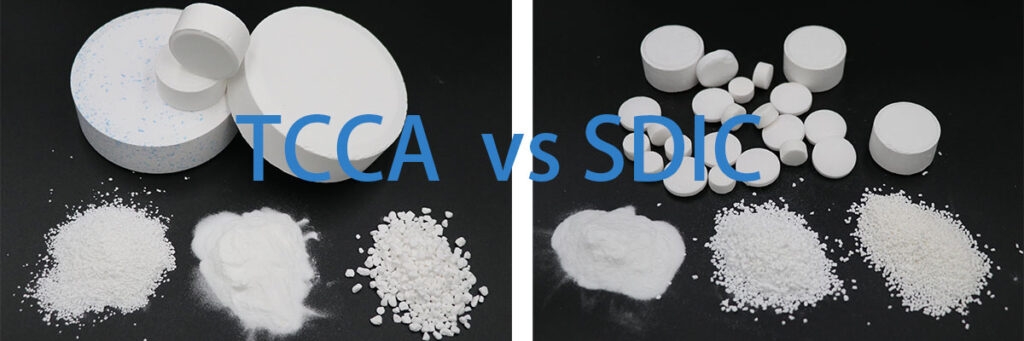
Trichloroisocyanuric Acid (TCCA) and Sodium Dichloroisocyanurate (SDIC) are the most widely used chlorine-based disinfectants. They both are effective at eliminating bacteria, viruses, and fungi, but they differ in chemical properties, performance, applications, and cost. TCCA and SDIC are essential in various industries, from water treatment and food processing to healthcare and household sanitation.
Would Like The Quotation
Leave more about your requirements, such as, brands, models, quantity, package, country, etc.
What Are TCCA & SDIC?
TCCA & SDIC are both chlorine-releasing disinfectants. They release hypochlorous acid (HOCl) when dissolved in water, which is the active component that kills microorganisms.
TCCA is a stable, high-efficiency disinfectant with a high available chlorine content, typically ≥90%. So TCCA is always known as TCCA 90. Its molecular structure, derived from cyanuric acid with three chlorine atoms bonded to nitrogen atoms, gives it strong oxidizing and chlorinating capabilities.
SDIC has a lower available chlorine content than TCCA, usually ranging from 56% to 62%. It is available in anhydrous or dihydrate forms and is known for its rapid dissolution and milder PH profile.
TCCA VS SDIC: Key Chemical Properties
>> Available Chlorine Content
Available chlorine is the most critical property of chlorine-based disinfectants, as it determines their disinfection strength and dosage requirements. TCCA has a significantly higher available chlorine content (≥90%) compared to SDIC (56–62%). This means less TCCA is needed to achieve the same disinfection effect as SDIC.
>> Solubility and Dissolution Rate
Solubility and dissolution rate affect how quickly the disinfectant takes effect and how it can be applied. TCCA has moderate solubility in water, about 1.2 g/100 ml at 25°C, and dissolves slowly, especially in tablet form. SDIC is more soluble (≥25 g/L at 25°C) and dissolves much faster, making it ideal for applications requiring immediate disinfection. This difference makes TCCA suitable for continuous treatment, while SDIC excels in shock treatments.
>> pH Value
The pH of a disinfectant solution influences its effectiveness and impact on the treated environment. 1% aqueous solution of TCCA has a pH of 2.7–3.3, making it acidic. And the 1% solution of SDIC has a more neutral pH of 5.5–7.0, which is less corrosive and gentler on materials and equipment. This makes SDIC a better choice for applications where pH stability is a priority.
>> Stability and Storage
Both TCCA and SDIC are stable under normal storage conditions, but TCCA is slightly more stable when dry. TCCA is hygroscopic and can decompose in high humidity or heat, releasing chlorine gas. SDIC also has good stability, with less than 1% loss of effective chlorine when stored for six months in a cool, dry place, and it does not deteriorate at 120°C or catch fire easily. They both require storage in well-ventilated areas away from combustibles.
TCCA vs SDIC: Disinfection Performance
>> Microbial Efficacy
Both TCCA and SDIC can kill a broad spectrum of microorganisms, including bacteria, viruses, fungi, and algae. Higher available chlorine content of TCCA means it can achieve the same level of disinfection with a lower dosage. SDIC, despite its lower chlorine content, is highly effective when used at the correct dosage, with a 99% fungicide ratio at 20 ppm.
>> Residual Chlorine Disinfection
Residual disinfection refers to the disinfectant’s ability to remain active in the treated medium to prevent recontamination. The performance of slow dissolution rate allows TCCA to release chlorine gradually, providing long-lasting residual protection. SDIC dissolute rapidly, which leads to faster initial disinfection but shorter residual activity, making it better for one-time or emergency treatments.
Applications: Is TCCA or SDIC Better for Your Industry?
>> Water Treatment Industry
TCCA is ideal for outdoor swimming pools, industrial circulating water, and wastewater treatment because of its long-lasting residual and UV stabilization.
SDIC is preferred for drinking water treatment, indoor swimming pools, and emergency water disinfection due to its rapid dissolution and neutral pH, which makes it gentler on water systems and human consumption.
>> Food and Beverage Industry
SDIC is often chosen for the disinfection of equipment, surfaces and food contact materials because of its neutral pH, which does not corrode equipment or affect food taste. It can also be used to sanitize tableware, processing equipment, and food storage areas. TCCA can also be used but may require additional rinsing to avoid residual acidity affecting food quality.
>> Healthcare and Sanitation
Healthcare facilities, hospitals, and public places require effective disinfection to prevent the spread of pathogens. SDIC is preferred for surface disinfection. TCCA is mainly used for more heavy-duty disinfection, such as in wastewater from healthcare facilities, where high chlorine levels are needed to kill resistant pathogens.
>> Household and Commercial Sanitation
For household use, SDIC is more common in disinfectant sprays, wipes, and cleaning products because of its safety, ease of use, and neutral pH. It is also used in hotels, restaurants, and public spaces for routine sanitization. TCCA is used in commercial settings where long-lasting disinfection is needed, such as in large-scale cleaning of public areas or industrial facilities.
>> Other Applications
TCCA can be used in textile bleaching, organic synthesis, and as a chlorinating agent in chemical processes due to its strong oxidizing properties.
SDIC can be used in aquaculture (fish, silkworms, livestock disinfection), wool shrinkage resistance, and textile bleaching.
TCCA vs SDIC: Cost Comparison
SDIC has a lower upfront cost per kilogram compared to TCCA. However, because TCCA has a 33% higher chlorine content, less of it is needed to achieve the same disinfection effect. For large-scale operations, the reduced dosage requirements means lower overall costs, including storage and handling expenses.
FAQs About TCCA and SDIC
1. Can TCCA and SDIC be used together for enhanced disinfection?
TCCA and SDIC can be used together in some cases. For example, SDIC can provide rapid initial disinfection (shock treatment), while TCCA maintains long-lasting residual protection. However, it’s important to calculate the total available chlorine to avoid over-dosage, which can cause irritation or equipment damage.
2. Which is better for swimming pool disinfection?
TCCA is better for outdoor swimming pools because its cyanuric acid component protects chlorine from UV degradation, providing long-lasting residual disinfection. SDIC is preferred for indoor pools, where UV exposure is low. In addition, due to its rapid dissolution and neutral pH, SDIC is much gentler on pool equipment and swimmers’ skin.
3. Is SDIC safer than TCCA for household use?
SDIC is generally safer for household use because of its neutral pH (5.5–7.0), which is less corrosive and irritating than TCCA’s acidic pH (2.7–3.3). It is commonly used in household disinfectants, wipes, and sprays, as it is gentler on skin and surfaces while still being effective against pathogens.
4. How does water pH affect TCCA and SDIC performance?
TCCA’s acidic nature can improve disinfection in alkaline water but may require pH adjustment in highly acidic water. SDIC’s neutral pH makes it less affected by water pH variations, making it more versatile in different water conditions.
5. What is the shelf life of TCCA and SDIC?
TCCA has a shelf life of 1–2 years when stored in cool, dry, sealed containers, as it absorbs moisture and decomposes over time. SDIC has a longer shelf life of 2–3 years under the same storage conditions, with less than 1% loss of effective chlorine over six months.
6. Which is better for drinking water treatment?
SDIC is preferred for drinking water treatment because of its neutral pH, which does not alter water pH significantly and is gentler on human consumption.
7. Which disinfectant is better for industrial wastewater treatment?
TCCA is better for industrial wastewater treatment because of its high available chlorine content and long-lasting residual disinfection. It is effective in high-COD wastewater streams and continuous treatment processes, requiring less volume than SDIC to achieve the same disinfection effect.
8. Are TCCA and SDIC environmentally friendly?
Yes, both TCCA and SDIC are environmentally friendly when used correctly. They break down into harmless byproducts (cyanuric acid, sodium chloride, water, and CO₂) that do not accumulate in the environment. However, overuse may lead to high cyanuric acid levels, so proper dosage and monitoring are important.