
PVC SG5 vs PVC SG8: Key Differences in Performance Applications and Grade Selection
Choosing between PVC SG5 and PVC SG8 can influence processing behavior, mold filling, extrusion stability, formulation requirements, and finished-product performance. Both are suspension PVC resins, but they occupy different molecular-weight ranges.
PVC SG5 generally has a higher molecular weight and is widely considered for rigid extrusion. PVC SG8 has a lower molecular weight and is often evaluated where easier flow is important, particularly in rigid injection molding.
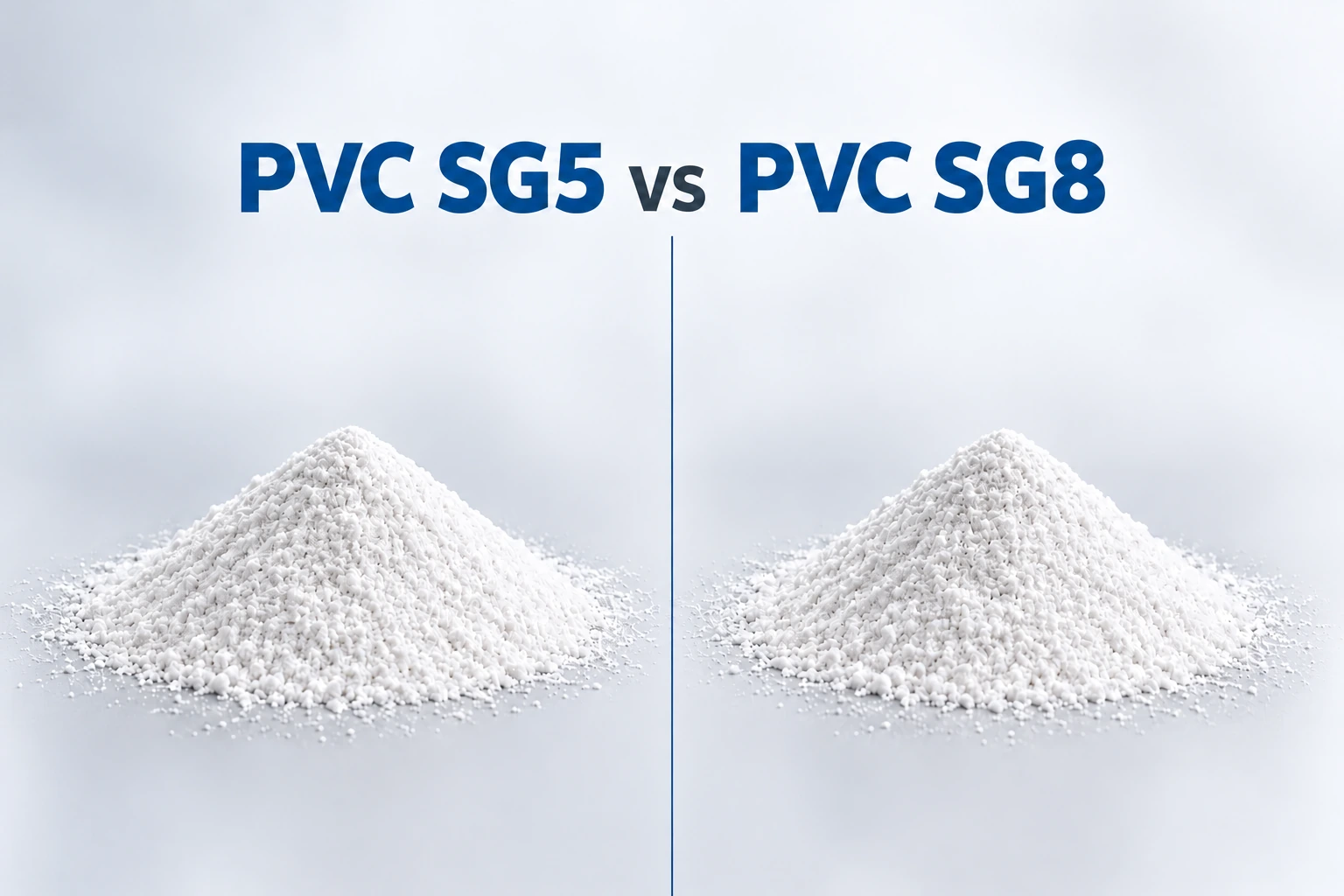
Understanding PVC SG5 and PVC SG8
What is PVC SG5
PVC SG5 is a suspension-polymerized polyvinyl chloride resin commonly associated with a K value around 67. Internationally, the designation "PVC K67" is perhaps more commonly used. It is supplied as a powder and compounded with stabilizers, lubricants, fillers, pigments, and other additives before conversion into finished products.
SG5 is an established starting point for many rigid extrusion formulations, including pipes, window and door profiles, electrical conduit, cable trunking, wall panels, and rigid sheets.
What is PVC SG8
PVC SG8 is a lower-molecular-weight suspension PVC grade commonly associated with a K value of 55–59. Some manufacturers designate this grade as "PVC SG8," while others may use different names—for instance, Sinopec’s "S700." Under comparable formulation and processing conditions, its lower molecular weight generally makes flow easier. It is therefore a candidate for injection-molded fittings, rigid accessories, and selected film, sheet, or profile formulations.
Technical Comparison at a Glance
| Parameter | PVC SG5 | PVC SG8 |
|---|---|---|
| Resin type | Suspension PVC resin | Suspension PVC resin |
| Common K value | 66–68 | 55–59 |
| Common viscosity number | 107–118 mL/g | 73–86 mL/g |
| Indicative degree of polymerization | 981–1135 | 650–740 |
| Relative molecular weight | Higher | Lower |
| General melt-flow tendency | Higher viscosity | Lower viscosity |
| Typical selection focus | Rigid extrusion and mechanical performance | Flow-sensitive rigid molding |
These numerical ranges are reference values published in a suspension PVC grade table, rather than specifications guaranteed for every manufacturer. Confirm the offered product against its technical data sheet and batch certificate of analysis.
Detailed Performance Comparison
The following comparisons describe general tendencies under comparable formulation and processing conditions. They are not guaranteed specifications for every commercial grade.
| Performance factor | PVC SG5 | PVC SG8 |
|---|---|---|
| Melt viscosity | Generally higher | Generally lower |
| Mold filling | May require more demanding conditions | Generally easier in flow-sensitive geometries |
| Melt strength | Generally higher | Generally lower |
| Mechanical-performance potential | Common starting point for demanding rigid extrusions | Suitable for many molded products with a qualified formulation |
Melt Viscosity and Mold Filling
PVC SG5 generally produces a more viscous melt than PVC SG8 when compound composition, temperature, and shear conditions are comparable. In injection molding, lower viscosity can help the material travel through runners, gates, and restrictive cavity sections. PVC SG8 is therefore often worth evaluating for detailed fittings and multi-cavity molds.
Melt Strength and Shape Retention
Melt viscosity describes resistance to flow, while melt strength concerns the hot material’s resistance to deformation before cooling. The higher molecular weight of SG5 PVC resin generally supports greater melt strength under comparable conditions, which can be useful when an extrudate must retain its shape before calibration and cooling.
SG8 PVC resin may flow more easily, but changing to it can alter stretching, sagging, and response to downstream handling. In foam extrusion, flow and melt strength must be balanced with the processing aid, blowing system, die design, and cooling conditions. Neither grade is automatically the best choice for every foam product.
Tensile Performance and Toughness
Higher molecular weight can support mechanical performance through greater chain entanglement. This helps explain why SG5 is commonly considered for rigid pipes and demanding profiles. Research has shown that both resin molecular weight and processing conditions influence PVC mechanical properties. An inadequately fused SG5 compound may perform worse than a properly developed lower-K compound.
Impact Resistance and Low Temperature Behavior
SG5 is not automatically impact-resistant, and SG8 is not automatically brittle. Impact behavior depends on modifier type and dosage, filler loading and dispersion, fusion quality, wall thickness, weld lines, notches, and test temperature. A properly modified SG8 fitting can meet its intended impact requirements, while a poorly processed SG5 profile may fail.
Hardness Stiffness and Flexibility
Both grades can produce rigid products when compounded without substantial plasticizer addition. Lower molecular weight does not make SG8 inherently soft, and higher melt viscosity does not automatically give SG5 a much higher elastic modulus.
Plasticizer type and content strongly influence flexibility. Fillers, modifiers, temperature, and geometry also affect stiffness. For hose, cable insulation, or artificial leather, consider plasticizer uptake, dry-blend behavior, and the required flexible-compound performance instead of selecting SG8 simply because it flows more easily.
Heat Resistance and Processing Thermal Stability
Service heat resistance and processing thermal stability are different properties. The former concerns behavior of the finished article at elevated temperatures and may be assessed through Vicat softening temperature, heat-deflection temperature, or dimensional changes. The latter concerns degradation during heat and shear exposure in the machine.
Neither property has a universal value established by the SG designation. A lower-viscosity SG8 compound does not automatically tolerate higher processing temperatures or longer residence times.
Fusion Behavior and Additive Requirements
PVC processing requires adequate fusion of the resin particles into a coherent material. Molecular weight matters, but particle morphology, porosity, lubrication, stabilizers, and processing aids also affect fusion. K value alone does not determine the ideal temperature or fusion time.
Appearance Chemical Resistance and Electrical Properties
Neither SG5 nor SG8 is automatically clearer, whiter, or glossier. Resin cleanliness, fish eyes, thermal history, additive compatibility, and dispersion influence appearance. For visual products, evaluate the actual surface and optical results.
Both share PVC chemistry, but chemical resistance must be assessed for the particular chemical, concentration, temperature, stress, and exposure time. Electrical insulation performance likewise requires compound-level qualification.
Detailed Application Comparison
Manufacturer portfolios support the general distinction between higher-K rigid extrusion grades and lower-K grades used for fittings and selected sheet products.
| PVC Grade | Main Applications |
|---|---|
| PVC SG5 | Rigid PVC pipes, window and door profiles, electrical conduit, cable trunking, wall panels, and rigid sheets. |
| PVC SG8 | Injection-molded pipe fittings, rigid molded accessories, rigid films and sheets, and selected foam boards and decorative profiles. |
Rigid Pipes and Drainage Products
Pipe extrusion requires adequate fusion, consistent wall thickness, stable calibration, and the required finished-product performance. SG5 is commonly evaluated for this balance. Pressure-pipe qualification must include the applicable long-term service requirements: an acceptable surface and short production trial are insufficient.
For non-pressure pipes, relevant checks may include dimensions, impact behavior, ring stiffness, and joint integrity, depending on the product specification. Foam-core and multilayer constructions need separate formulation and layer-specific assessment.
Injection Molded Fittings
Elbows, tees, couplings, and adapters may include cores, changing wall thicknesses, and flow restrictions. SG8 can be useful where cavity filling is a key concern. However, the finished fitting must also provide sound weld lines, correct dimensions, adequate impact performance, and reliable joints.
An intermediate-K resin may offer a more suitable balance of flow and mechanical performance for some molds. The lowest K value is not automatically the best choice.
Window Profiles and Decorative Trims
Window profiles may need to withstand welding, handling, outdoor exposure, and temperature changes while maintaining mechanical and dimensional performance. PVC K67 SG5 is a common candidate for these demanding formulations.
Decorative trims may place a different emphasis on appearance, processing, and cost. SG8 may be evaluated for selected decorative or specialized profiles.
Rigid Film Sheet and Thermoforming
Selected lower-K suspension grades are used for rigid film and sheet because their processing characteristics can suit extrusion, calendering, and subsequent forming. Consider sheet uniformity, thermoforming behavior, optical quality, and finished-part impact performance together.
Foam Boards and Foamed Profiles
Changing molecular weight alters the balance between flow and support of growing foam cells. An easier-flowing resin may require a revised processing-aid package or operating conditions to maintain cell stability and surface quality.
Compare foam density, cell uniformity, skin quality, dimensional stability, and mechanical performance. There is no universal SG5-to-SG8 substitution ratio for foam production.
FAQs
1. Is PVC SG8 Better Than PVC SG5?
Neither grade is universally better. SG5 is commonly selected for rigid extrusion, while SG8 generally offers easier flow for suitable injection-molding applications. Choose according to finished-product requirements, formulation, and equipment. Compare production stability and tested product performance rather than treating the SG number as an indicator of quality.
2. Does PVC SG8 Have a Higher Molecular Weight Than SG5?
No. SG8 has a lower molecular weight than SG5 in the conventional SG classification. SG5 commonly has a K value of 66–68, compared with 55–59 for SG8. Always confirm the supplier’s technical data, since commercial grade names do not necessarily follow the same classification system.
3. Is PVC SG8 a Soft PVC Resin?
SG8 is not inherently soft and can produce rigid fittings and molded accessories. Finished-product flexibility depends mainly on plasticizer type and content, together with other formulation ingredients. Easier melt flow does not mean greater softness after cooling. Select flexible-product resins according to compound requirements and production trials.
4. Which Grade Is More Suitable for PVC Pressure Pipes?
SG5 is a common starting point for rigid PVC pressure-pipe formulations. However, its designation alone does not guarantee pressure-service suitability. The specific resin, formulation, and finished pipe must satisfy applicable requirements, including relevant dimensional, mechanical, and hydrostatic tests. Substituting SG8 requires technical qualification rather than a simple processing comparison.
5. Which Grade Is More Suitable for Injection-Molded PVC Fittings?
SG8 is often evaluated for rigid injection-molded fittings because its lower viscosity can help fill restrictive cavities. However, fittings must also meet dimensional, impact, weld-line, and joint-performance requirements. Depending on the mold and application, an intermediate-K resin may provide a better balance between flow and mechanical performance.
6. Does PVC SG8 Require a Lower Processing Temperature Than SG5?
Not necessarily. Although SG8 generally flows more easily, suitable temperatures depend on formulation, equipment, shear, and residence time. Excessively low temperatures can cause inadequate fusion, while excessive heat can cause degradation. Establish processing conditions through controlled trials, monitoring actual material temperature, appearance, fusion quality, and finished-product performance.
7. Is PVC SG5 Always More Impact Resistant Than SG8?
No. Higher molecular weight can support mechanical performance, but impact resistance also depends on modifiers, filler dispersion, fusion quality, wall thickness, weld lines, and temperature. A properly formulated SG8 product may outperform a poorly processed SG5 article. Compare finished products using the relevant test method and service conditions.
8. Can PVC SG8 Replace PVC SG5?
SG8 may replace SG5 in some applications, but substitution requires formulation and processing trials. Easier flow can accompany changes in melt strength, fusion, dimensions, and mechanical performance. Identify the existing production limitation, record baseline results, and approve the replacement only after the finished product meets its defined requirements.
9. Can I Change PVC Brands While Keeping the Same SG Grade?
Yes, but identical SG designations do not guarantee identical behavior. Producers’ resins can differ in particle size, porosity, bulk density, and fusion characteristics. Compare technical documents and conduct production trials before approving a change. Check feeding consistency, processing stability, appearance, and finished-product performance using the proposed formulation and equipment.
10. What Information Should I Provide When Buying PVC SG5 or SG8?
Provide your product type, processing method, current resin, required performance, and any production problems. For quotations, include preferred producer, quantity, packaging, and destination port. Request the offered grade’s technical data sheet and a relevant certificate of analysis, then confirm suitability through trials with your formulation and equipment.
Sourcing PVC Resin from Chemate Group
Chemate Group supplies PVC resin for manufacturers comparing grades and producer options. For a relevant quotation, provide your application, required SG grade or K-value range, preferred manufacturer, order quantity, and destination port. If replacing an existing material, its technical data sheet can help clarify the comparison.
Explore PVC resin options at PVC resin. The purchasing objective should be a consistently suitable material supported by clear documentation and practical supply arrangements.