
Chemate Group / PVC Resin Technical Guide
How to Choose PVC Resin for Wallpaper Manufacturing
Choosing PVC resin for wallpaper manufacturing starts with understanding how the wallpaper is produced. A resin suitable for a coated, foamed wallcovering may behave differently from one used to make a calendered decorative film. Even two paste PVC grades with similar K values can produce different coating viscosity, foam structure and surface appearance.
For manufacturers, the right choice is the grade that consistently meets the finished wallpaper specification on the available equipment. Resin price matters, but so do coating stability, processing speed, defect rates and the amount of adjustment required between batches.
Start with the Wallpaper Structure and Production Process
PVC wallpaper covers several product constructions. Before comparing resin grades, identify the substrate, decorative layer and processing method.
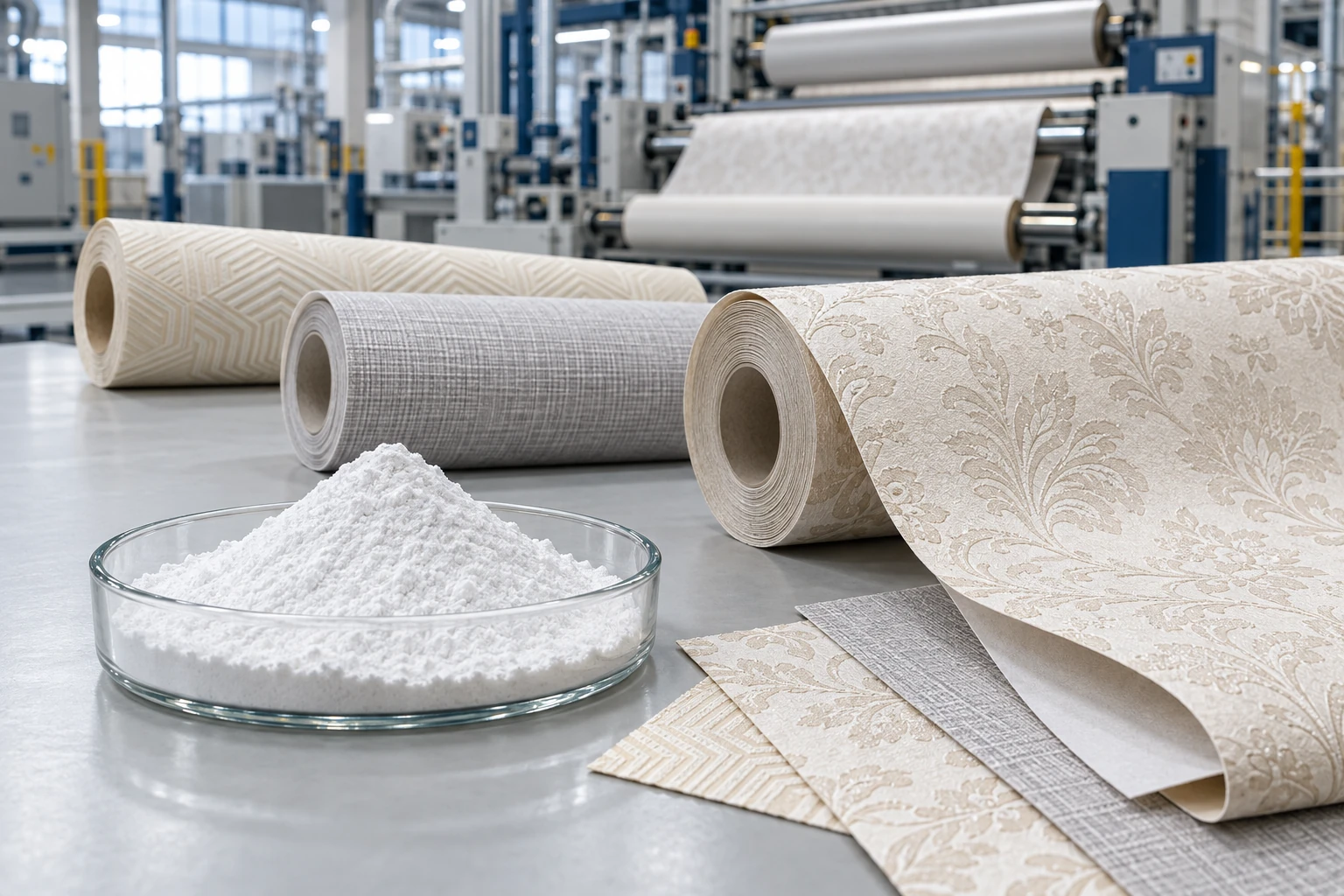
Common structures include compact vinyl coatings, foamed vinyl layers and embossed surfaces on paper or nonwoven backing. Manufacturer guidance identifies spread coating, rotary screen printing and gravure application among the production routes used for these wallcoverings. Each places different demands on the PVC resin material.
Prepare a short production description rather than simply asking about "wallpaper grade PVC” before approaching a PVC resin supplier:
- Backing material: paper, nonwoven or another substrate.
- Application method: coating, screen application or film lamination.
- Surface structure: compact, foamed, smooth or embossed.
- Layer construction: single coating or several functional layers.
- Operating conditions: coating weight, line speed and oven profile.
- Finished requirements: appearance, flexibility, adhesion and customer specifications.
Choose the Correct PVC Resin Type
PVC Paste Resin for Plastisol Processing
For wallpaper produced by applying a liquid PVC plastisol, PVC paste resin is the relevant material.
A plastisol contains fine PVC particles dispersed in a liquid plasticizer system, together with additives selected for the application. During heating, the PVC absorbs plasticizer, gels and fuses to form the coating.
Paste resin selection therefore involves more than the strength of the finished material. Wallpaper manufacturers also need to consider how the liquid formulation mixes, flows, releases air and changes during storage.
Suspension PVC Resin for Film-Based Processes
If the production route involves making a flexible PVC film by calendering and then laminating it to a backing, a suitable suspension PVC resin may be appropriate.
The selection criteria then shift toward dry-blend preparation, plasticizer absorption, fusion, melt processing and film quality.
Ordinary suspension PVC and paste PVC should not be treated as interchangeable materials. A suspension grade carrying a familiar SG designation is not automatically suitable for a wallpaper plastisol. Similarly, a specialty blending or extender resin intended for use in a paste formulation should not be confused with general-purpose suspension resin.
Understand What K Value Can and Cannot
K value is an indicator related to PVC molecular weight. It helps manufacturers compare grades, but it does not provide a complete description of wallpaper processing performance.
A common purchasing mistake is to assume that two resins with similar K values will behave the same way in production. In practice, grades can differ in particle characteristics, plastisol rheology, fusion response and formulation compatibility.
For wallpaper applications, use K value as an initial screening parameter. Then assess the properties that directly affect your process.
| Selection parameter | Question to answer |
|---|---|
| Resin type | Is the grade designed for plastisol processing or thermoplastic film production? |
| K value | Is its molecular-weight range appropriate for the intended formulation and finished properties? |
| Paste viscosity | Can the formulation be mixed, pumped and applied consistently? |
| Viscosity stability | Does the paste remain usable over the required holding period? |
| Fusion response | Can the coating fuse within the available heating conditions? |
| Foam performance | Does the formulation produce the required density and cell structure? |
| Surface quality | Does the finished layer meet color, texture and appearance requirements? |
There is no single K value that can be recommended for every wallpaper construction. A practical choice must account for the resin grade, formulation and processing equipment together.
Evaluate Plastisol Viscosity Under Comparable Conditions
For coated wallpaper, plastisol viscosity is one of the most useful selection criteria. However, a viscosity number has little value without its test conditions.
When comparing supplier data, check:
- Plasticizer type and loading.
- Presence of fillers or other additives.
- Mixing method.
- Time between preparation and measurement.
- Test temperature.
- Instrument, spindle and rotational speed, where applicable.
Match Flow Behavior to the Application Method
A paste must flow during application while retaining enough control to produce the intended coating or pattern. The lowest viscosity is therefore not automatically the best result.
For a production trial, assess whether the formulation:
- Spreads evenly at the target coating weight.
- Transfers consistently through the application equipment.
- Maintains pattern definition where required.
- Avoids excessive running or uneven buildup.
- Remains stable over the normal production period.
Check Viscosity After Holding
Wallpaper production may involve a delay between paste preparation and application. Evaluate the candidate resin over that actual holding period.
Measure fresh viscosity and repeat the test at agreed intervals using the same method. Also inspect for settling, separation and changes in handling.
The objective is a predictable processing window that fits the factory’s mixing and production schedule.
Assess Foaming Performance for Textured Wallpaper
For foamed wallpaper, resin selection must be evaluated within the complete foam formulation.
The finished structure depends on the relationship between fusion, gas generation and the ability of the material to retain the developing cells. Plasticizer, blowing-agent system, filler level and heating conditions also influence the result.
Compare candidates at an equivalent finished specification. A sample with greater expansion may not be preferable if it has weak structure, uneven texture or poor embossing performance.
Keep the reference formulation and operating conditions documented so that differences can be investigated rather than attributed automatically to the resin.
Check Fusion and Heat Exposure Together
A resin must work within the heating capability of the production line.
Insufficient fusion can leave a coating with weak mechanical performance or an unsatisfactory surface. Excessive heat exposure can cause discoloration or damage other components of the wallcovering.
During trials, record the complete oven profile and line speed. Oven set temperature alone does not describe the temperature reached by the coating.
Evaluate:
- Whether the layer fuses adequately at the intended speed.
- Color after the normal heating cycle.
- Behavior during slower operation or temporary stoppages.
- Flexibility and integrity after cooling.
- Consistency across the web.
Inspect Surface Quality and Embossing Results
Wallpaper is a decorative product, so visual consistency deserves as much attention as processing efficiency.
Assess trial material under repeatable lighting and compare it with an approved reference. Examine the full web width and samples taken at different points during the run.
Useful inspection items include:
- Base color and whiteness.
- Specks or visible contamination.
- Pinholes and entrapped-air defects.
- Coating smoothness.
- Gloss or matt appearance.
- Pattern definition.
- Embossing depth and consistency.
For hot-embossed wallpaper, inspect the product after cooling and winding as well as immediately after embossing. The appearance at the embossing station is only part of the finished-product assessment.
Validate the Resin with Your Actual Additives and Backing
A resin cannot be approved independently of the formulation in which it will be used.
Plasticizer Compatibility
Test with the intended plasticizer system. A change in plasticizer may affect paste viscosity, fusion behavior, flexibility and storage stability.
If the customer requires a particular plasticizer system, use it during qualification rather than assuming results from a different formulation will transfer directly.
Filler Loading
Fillers influence processing and finished properties. When comparing resins, keep filler type, particle characteristics and loading controlled during the initial evaluation.
If a candidate requires formulation adjustments, record them separately. This makes it easier to understand both the technical benefit and the cost.
Backing and Adhesion
Test coating-to-backing adhesion using the actual paper or nonwoven substrate.
Adhesion problems can involve substrate characteristics, primer, formulation, coating penetration and heating conditions. A resin change alone may not resolve them.
Odor and Finished-Product Requirements
Assess odor and any required emissions performance on the finished wallpaper.
A raw-resin document does not establish the performance of the complete product, which also contains plasticizers, stabilizers, pigments, inks, adhesives and backing materials. Confirm the customer’s testing requirements before final approval.
Request Useful Technical Documents from the PVC Resin Supplier
A quotation should identify the exact manufacturer and grade.
Before ordering a trial quantity, request:
- Technical data sheet.
- Safety data sheet.
- Relevant batch certificate of analysis.
- Recommended applications and processing route.
- Paste-viscosity test conditions, where applicable.
- Available information on fusion, foaming and formulation compatibility.
- Packaging, storage and shelf-life guidance.
Distinguish typical technical values from guaranteed supply specifications. A property shown on a technical data sheet may be useful for comparison without being included in every batch release test.
Also agree on how future changes will be handled. Manufacturer, grade and production source should remain traceable throughout repeat supply.
Sourcing PVC Resin for Wallpaper Manufacturing
When discussing PVC resin requirements with Chemate Group, provide the production process and target wallpaper properties alongside the requested quantity.
A useful inquiry includes your current resin grade, coating method, backing material, foamed or compact construction, plasticizer system and the main problem you want to solve.
If you are seeking an alternative supplier, explain whether the objective is lower cost, more stable viscosity, improved appearance or more reliable supply. This makes grade comparison more focused. Confirm the availability and technical suitability of any proposed material before purchasing a commercial shipment.
FAQs
1. What type of PVC resin is used for wallpaper manufacturing?
PVC paste resin is used for wallpaper made through plastisol coating processes. A film-based route involving calendering may use an appropriate suspension PVC resin. The correct choice depends on how the decorative layer is manufactured and applied to the backing.
2. Can SG-5 PVC resin be used to make wallpaper?
An SG-5 designation alone does not establish suitability. For plastisol-coated wallpaper, ordinary SG-5 suspension resin should not be assumed to replace paste resin. If the process uses calendered film, assess the specific suspension grade against the formulation and production requirements.
3. What is the best K value for wallpaper-grade PVC?
There is no universal best K value. Select a grade by evaluating resin type, paste rheology, fusion, foam behavior and finished properties. Two grades with similar K values may still perform differently on the same line.
4. Is lower plastisol viscosity always better?
No. The formulation needs an appropriate balance of flow, application control and stability. Very low viscosity may not provide the desired coating or pattern behavior. Compare candidate resins under the same test conditions and then validate them on the production equipment.
5. Why does a new resin change wallpaper foaming performance?
Different grades can change the way a formulation gels, fuses and retains gas during expansion. However, foaming also depends on additives and heating conditions. Investigate the complete formulation and process before concluding that the resin alone caused the change.
6. Can the same PVC resin be used for compact and foamed wallpaper?
Some grades may be suitable for multiple applications, but this requires confirmation. Compact coatings and foamed layers have different priorities. A PVC resin that produces a satisfactory smooth coating still needs separate evaluation for expansion, cell structure and foam strength.