
PET APPLICATION INSIGHTS
Why Do PET CSD Bottle Bases Crack?
A PET carbonated soft drink bottle can look clear, meet its target weight and survive filling, yet develop a crack in the base during storage or distribution. For CSD bottle manufacturers, these delayed failures are particularly difficult: the defect may appear after the finished product has already left the factory.
PET CSD bottle bases can crack when sustained internal pressure acts on vulnerable regions created by material degradation, uneven stretching, local defects or unsuitable base geometry. Contact with stress-cracking agents can further accelerate failure. Investigating the problem therefore requires examining the resin, preform, blow-molding process and filled-bottle environment together.
This article explains how these factors interact and presents a practical approach to identifying the source of PET bottle base cracking.
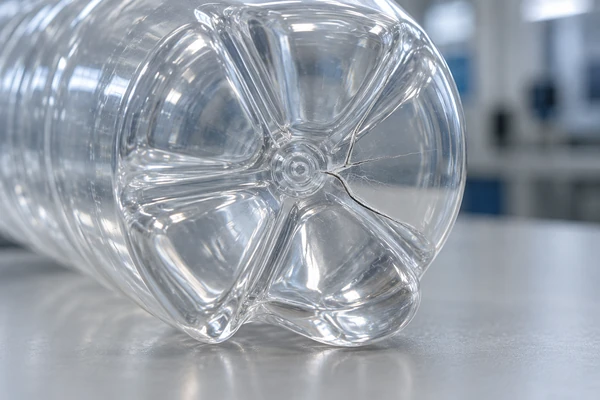
What Is PET Bottle Base Stress Cracking?
Stress cracking is the development and growth of cracks in PET under stress. In carbonated beverage packaging, the bottle remains loaded by internal pressure throughout much of its service life. Local weaknesses can become crack initiation sites, allowing a small defect to develop into a leak or more extensive failure.
Environmental stress cracking involves the combined action of stress and exposure to a substance that promotes cracking. PET bottle laboratories use controlled chemical exposure to evaluate this susceptibility. For example, PTI describes a bottle-base stress-cracking procedure using a 0.2% sodium hydroxide solution. This is an accelerated test condition, rather than a statement about normal beverage contact. [1]
It is useful to distinguish several failure modes:
| Failure mode | Typical observation | Main investigation direction |
|---|---|---|
| Delayed base cracking | A crack or leak develops after filling or storage | Sustained stress, local material structure and chemical exposure |
| Immediate pressure failure | Bottle fails during a pressure test or soon after filling | Pressure loading, defects, material distribution and design |
| Base deformation or rollout | Base changes shape or loses standing stability | Base geometry, thermal conditions and pressure resistance |
| Impact damage | Failure follows dropping or mechanical contact | Handling conditions, contact points and local damage |
These symptoms can overlap. The appearance of a failed bottle provides a starting point, but the cause should be confirmed through comparative testing.
Why Is the Bottle Base a Critical Region?
The base of a CSD bottle must contain pressure while providing stable support. Its geometry includes transitions between the central gate area, feet, valleys and lower sidewall.
During stretch blow molding, these regions experience different deformation histories. Material near the gate does not necessarily stretch in the same way as material farther from the center. Consequently, the base can contain regions with different thickness, orientation and mechanical response.
This helps explain why total bottle weight alone cannot describe base reliability. Two bottles with the same weight may distribute that material differently. Even similar thickness measurements may conceal differences in how the PET was stretched.
A 2026 study used digital photoelasticity to examine deformation in 3.0 L PET bottle bases. The authors identified distinct stretching regions and showed that pre-blow pressure affected their distribution. Within the investigated window, increasing pre-blow pressure from 0.5 to 0.9 MPa reduced the measured radial stretching distance near the gate from approximately 9.0 mm to 7.5–8.1 mm. These results demonstrate process sensitivity. They do not establish a universal optimum pressure or prove that increasing pressure always improves crack resistance. [2]
How PET Resin Selection Affects Base Performance
Selecting a resin intended for carbonated beverage bottles is an important starting point. However, a suitable resin must also retain its properties through preform production and be processed into an appropriate bottle structure.
Intrinsic Viscosity Must Be Evaluated Across Processing Stages
Intrinsic viscosity, or IV, is an indicator related to PET molecular weight. It is useful for material selection and monitoring processing-related changes.
For a cracking investigation, the incoming resin COA is only one part of the evidence. Manufacturers should consider comparing:
- Incoming resin IV.
- Preform IV.
- Bottle IV, where appropriate.
- Results from a known good production run.
Use comparable test methods and sampling procedures. A difference between laboratories should be investigated before it is interpreted as material degradation.
The practical question is whether the approved resin specification is maintained sufficiently through processing to support the validated bottle design.
Higher IV Cannot Compensate for Every Other Weakness
Using CSD bottle grade PET resin with a higher IV may be worth evaluating when the existing material is unsuitable for the application. It should not be treated as a guaranteed correction for a damaged preform, poorly stretched base or chemical exposure problem.
Resin formulation also matters. Patent literature on stress-crack-resistant polyester compositions discusses both molecular weight and copolyester composition, illustrating why nominal IV alone does not fully define stress-cracking performance. Patent examples remain formulation-specific evidence and should not be treated as general performance guarantees. [3]
When comparing candidate grades, review the producer’s intended application, technical documentation and results from controlled bottle trials.
Can Inadequate Drying Cause PET Bottle Bases to Crack?
Inadequate drying can weaken the material before the bottle is formed.
PET absorbs moisture. During melt processing, residual moisture can cause hydrolytic degradation, reducing molecular weight and affecting processing control and mechanical properties. For troubleshooting, check actual drying performance rather than relying only on the temperature displayed on the dryer.
Relevant checks include:
- Residual moisture at the point of processing.
- Actual pellet temperature and residence time.
- Dry-air flow and dryer performance.
- Hopper throughput and material level.
- Moisture pickup during conveying.
- Startup, shutdown and production-interruption practices.
Use the resin producer’s drying recommendations and the equipment supplier’s operating guidance. A drying recipe that worked at one throughput may require reassessment after a substantial production-rate change.
If IV loss increases during preform production, drying is one area to investigate alongside melt temperature and residence time.
What Preform Problems Can Contribute to Base Cracking?
The preform determines the starting geometry and material condition for stretch blow molding. A bottle-base problem may therefore originate during injection molding.
Gate and Bottom-Region Defects
Inspect the preform gate and surrounding bottom region for visible damage, voids, inclusions or inconsistent appearance. Compare preforms associated with failed bottles against retained samples from successful production.
Where possible, trace failures to injection cavities. A defect concentrated in one cavity warrants a different investigation from a problem affecting all cavities equally.
Visible appearance alone is insufficient to confirm the mechanism. Suspicious regions may require microscopy, sectioning or other laboratory analysis.
Excessive or Inconsistent Thermal History
Review melt temperature, hot-runner conditions, residence time and restart procedures. An acceptable PET resin specification does not guarantee that every preform receives the same processing history.
A useful investigation asks whether the problem correlates with:
- Extended machine stops.
- Changes in output.
- Particular injection cavities.
- Changes in resin handling.
- A specific production shift or startup period.
Preform Design Compatibility
A preform must provide suitable material distribution and stretching potential for the intended CSD bottle.
If bottle volume, weight or base geometry changes, an existing preform should be revalidated. Reusing a familiar preform does not establish that it will produce the required base structure in a different bottle.
How Reheating and Stretch Blow Molding Affect the Base
The blowing recipe controls how the preform becomes the finished bottle. Temperature distribution, stretch-rod movement and air delivery must work together.
Preform Temperature Distribution
Evaluate the temperature profile relevant to the base-forming region, rather than focusing only on an average preform temperature.
For process trials, review oven-zone settings, preform rotation, ventilation, transfer conditions and production speed. The objective is to achieve repeatable deformation and material distribution.
Avoid prescribing a single temperature correction from the crack appearance alone. Whether a region needs more or less heating depends on the actual preform, bottle design and observed deformation.
Stretch-Rod Alignment and Motion
Check rod alignment, condition and movement against the machine specification.
An off-center gate or asymmetric base distribution is a reason to investigate centering and material movement. It does not, by itself, prove that the stretch rod is responsible.
Compare results by blowing station. A station-specific problem may indicate equipment or mold conditions that would be hidden in an overall production average.
Pre-Blow Pressure and Timing
Pre-blow influences the early expansion of the preform. Pressure, timing and the relationship to rod movement should therefore be evaluated as interacting variables.
The 2026 optical study supports this approach: changes in pre-blow pressure measurably altered base deformation. Its findings support controlled trials, rather than copying a pressure value from another machine or bottle format. [2]
Record both the process settings and the resulting bottle properties. A visually improved base should still undergo performance testing.
Final Blowing and Cooling
Review final pressure delivery, mold contact, base-insert condition and cooling consistency. For recurring failures, compare mold stations and check whether the affected bottles share a particular cooling circuit or base insert. Process changes should be assessed across the full operating window, including startup and normal production.
Why Base Geometry and Material Distribution Matter
A petaloid base uses multiple feet and valleys to provide support while containing pressure. Its performance depends on the interaction between geometry and the material structure produced during blowing.
Equipment suppliers develop specific CSD base designs to improve this balance. Sidel’s StarLite CSD documentation, for example, reports stress-cracking improvements for its own evaluated bottle designs. Such supplier results demonstrate that geometry can matter, but the reported gains cannot be transferred automatically to another bottle. [4]
For an existing design, review:
- Thickness around the gate, feet, valleys and transitions.
- Symmetry of material distribution.
- Local damage or molding defects.
- Base stability under the intended pressure and temperature.
- Performance after handling and distribution simulation.
Adding material does not automatically correct poor distribution or unsuitable deformation. Weight changes should be evaluated together with geometry and the blowing process.
How Filling, Chemicals and Storage Can Expose Weaknesses
A bottle that performs well immediately after blowing may behave differently after filling and distribution.
Investigate the conditions the bottle actually encounters:
- Carbonation and internal pressure.
- Product and storage temperature.
- Conveyor lubricant contact.
- Cleaning chemical residues.
- Duration of storage.
- Mechanical damage during handling.
Laboratory stress-cracking tests deliberately combine controlled loading and chemical exposure to assess susceptibility. A published study of CSD bottle failures also identifies interacting factors including internal pressure, IV, material distribution, temperature and contact with caustic substances. [5]
A Practical Troubleshooting Sequence for PET CSD Base Cracks
1. Preserve Failed Bottles and Production Records
Retain failed bottles, unused bottles from the same run, associated preforms and resin samples where available.
Record when the failure occurred and whether it followed filling, storage, transport or a laboratory test.
2. Map the Failure Pattern
Identify the crack location and check whether failures cluster by resin lot, injection cavity, blowing station or production period.
A repeatable pattern often provides more diagnostic value than inspecting one bottle in isolation.
3. Compare Material Condition
Review COA results and test resin-to-preform IV retention where warranted. Check residual moisture and processing records using agreed methods.
4. Examine the Base Structure
Measure local thickness and distribution. Compare gate position, symmetry and visible defects.
If conventional measurements do not explain the failure, consider specialist analysis of orientation or deformation.
5. Run Controlled Process Trials
Keep the material, preform and test conditions consistent while evaluating selected process variables.
Use a structured trial plan when several factors may interact. Retain a known good control wherever possible.
6. Validate the Filled Package
Confirm performance using the customer’s applicable testing requirements and realistic distribution conditions. Assess leakage, delayed cracking, pressure performance and base stability.
A successful short trial is a useful milestone. The validation should also cover the conditions associated with the original failure.
What Resin Buyers Should Share With Their Supplier
When requesting PET resin for a CSD application, provide more than the bottle volume.
Useful information includes preform weight and design, bottle geometry, carbonation requirements, manufacturing equipment, intended storage conditions and relevant test criteria.
For a cracking complaint, add failure photographs, production traceability and a description of when the problem appears.
Sharing these details helps focus grade discussions and documentation requests on the actual production requirement. Candidate materials should then be confirmed through trials using the intended preform and bottle design.
FAQs
1. Does a cracked CSD bottle base mean the PET resin is defective?
It may indicate a material problem, but the crack alone does not establish responsibility. Check resin and preform properties alongside bottle structure, blow-molding conditions, chemical contact and pressure loading. Traceability and comparison with successful production are essential for separating material-related causes from processing or service conditions.
2. Can increasing PET IV solve base cracking?
It may help when the selected material lacks the required performance, but it cannot guarantee a solution. Review IV retention through preform production and validate any replacement grade in the actual bottle. Base geometry, stretching and chemical exposure can remain limiting factors after a resin change.
3. Why do CSD bottles with the same weight show different cracking performance?
Equal weight does not ensure equal local thickness or deformation history. Material may be distributed differently around the gate, feet and valleys. Differences in preform temperature and blowing conditions can also produce different structures, making bottle weight an incomplete indicator of base reliability.
4. Is a thicker base always more resistant to cracking?
There is no universal relationship that makes thickness alone sufficient. Local geometry, stretching and material condition also matter. Adding weight may change the result, but the revised bottle should be tested for stress cracking, pressure performance and standing stability under the intended service conditions.
5. Should pre-blow pressure be increased when base cracks appear?
There is no universally correct direction. Pre-blow interacts with temperature, timing, rod movement, preform geometry and bottle design. Establish the current deformation and failure pattern, then evaluate controlled changes. Confirm any improvement through performance testing rather than selecting a setting from visual appearance alone.
6. Can poor drying contribute to the problem?
Yes. Inadequately dried PET can undergo hydrolytic degradation during melting, reducing molecular weight and affecting properties. Verify residual moisture and drying-system performance at the actual production throughput. Then assess whether the resin-to-preform IV change supports drying-related degradation as part of the failure mechanism.
7. What should be checked first when failures occur in only one blowing station?
Compare that station’s base insert, cooling, pressure delivery, alignment and resulting material distribution with successful stations. Keep preform and resin conditions comparable during the assessment. Station-specific failure is a useful diagnostic clue, but the suspected equipment condition still needs confirmation through inspection and controlled trials.
References
[1] Plastic Technologies Inc. ISBT and Special Protocols.
[2] Prasath, R. G. R., Zagarola, S., and Danyluk, S. Processing–Structure–Performance Relationships in Stretch Blow-Molded Polyethylene Terephthalate Bottles: Optical Quantification of Deformation and Stress-Crack Resistance. First published July 25, 2026. DOI: 10.1002/pen.70766.
[3] Polyester composition for improved stress crack resistance in polyester articles. US Patent 8,968,849, issued March 3, 2015.
[4] Sidel. StarLite CSD for Carbonated Soft Drinks.
[5] Stress-cracking of PET bottle as an unpredictable factor limiting the commercial life of carbonated soft drinks.