
Home » mLLDPE vs LLDPE
mLLDPE and LLDPE are two of the most widely used polyethylene materials in the global plastics industry. Although both belong to the Linear Low Density Polyethylene (LLDPE) family, they are not the same material. The biggest difference lies in the catalyst technology used during polymerization, which directly affects strength, sealability, puncture resistance, clarity, and processing performance.
What Is LLDPE?
LLDPE (Linear Low Density Polyethylene) is a copolymer of ethylene with alpha-olefins such as butene, hexene, or octene. It is traditionally produced using Ziegler–Natta catalysts, making it one of the most economical polyethylene materials for flexible packaging.
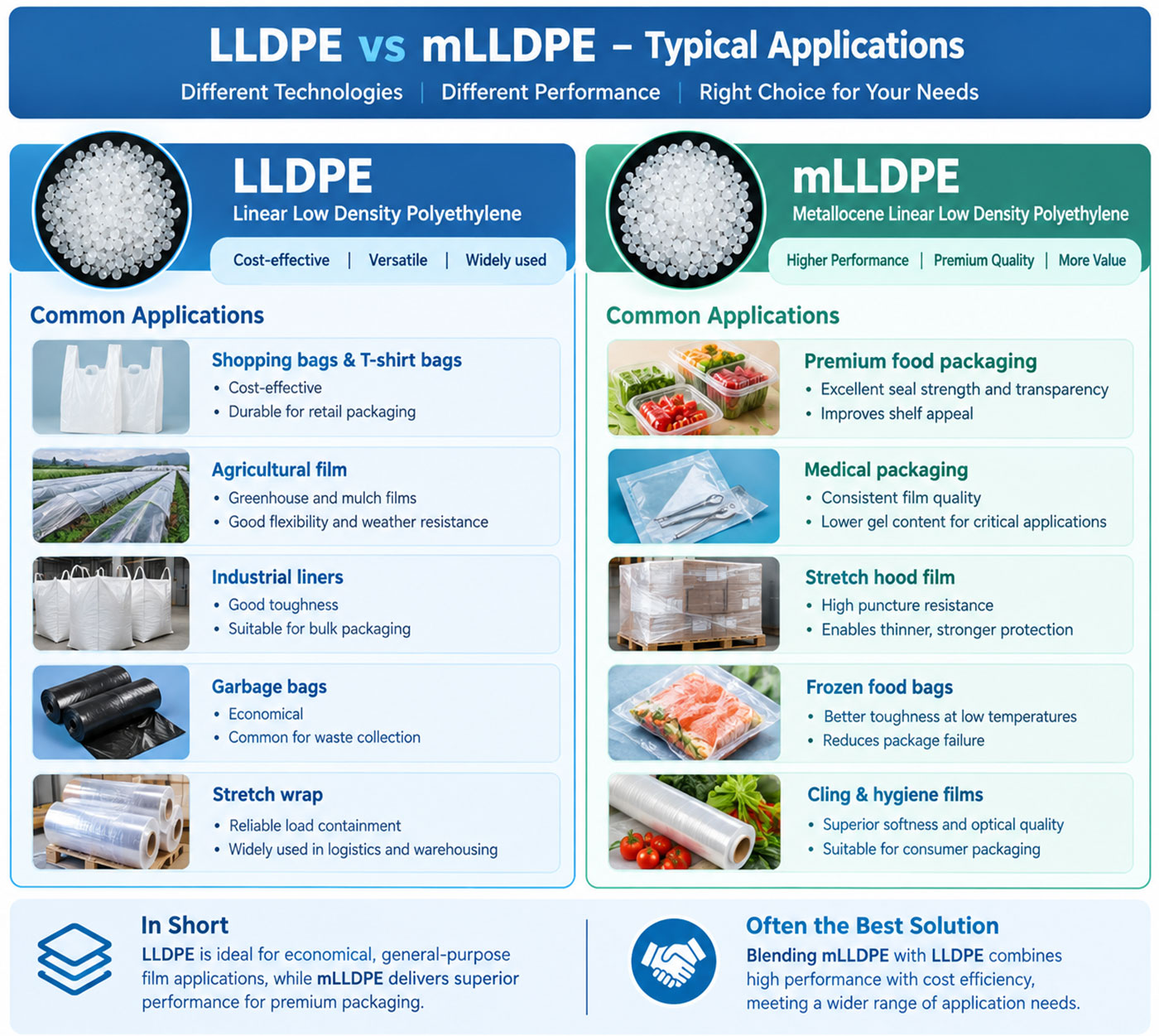
LLDPE is commonly used in blown film, stretch film, shopping bags, agricultural film, and industrial packaging.
What Is mLLDPE?
mLLDPE (Metallocene Linear Low Density Polyethylene) is a newer generation of LLDPE produced using metallocene single-site catalyst technology. Unlike conventional catalysts, metallocene catalysts create highly uniform polymer chains and a narrow molecular weight distribution.
Typical characteristics of mLLDPE
Superior puncture resistance
Higher tear strength
Better hot tack and heat sealing
Excellent transparency and gloss
Lower gel content
Outstanding toughness
Because of these advantages, mLLDPE is widely used in premium packaging films and high-performance industrial applications.
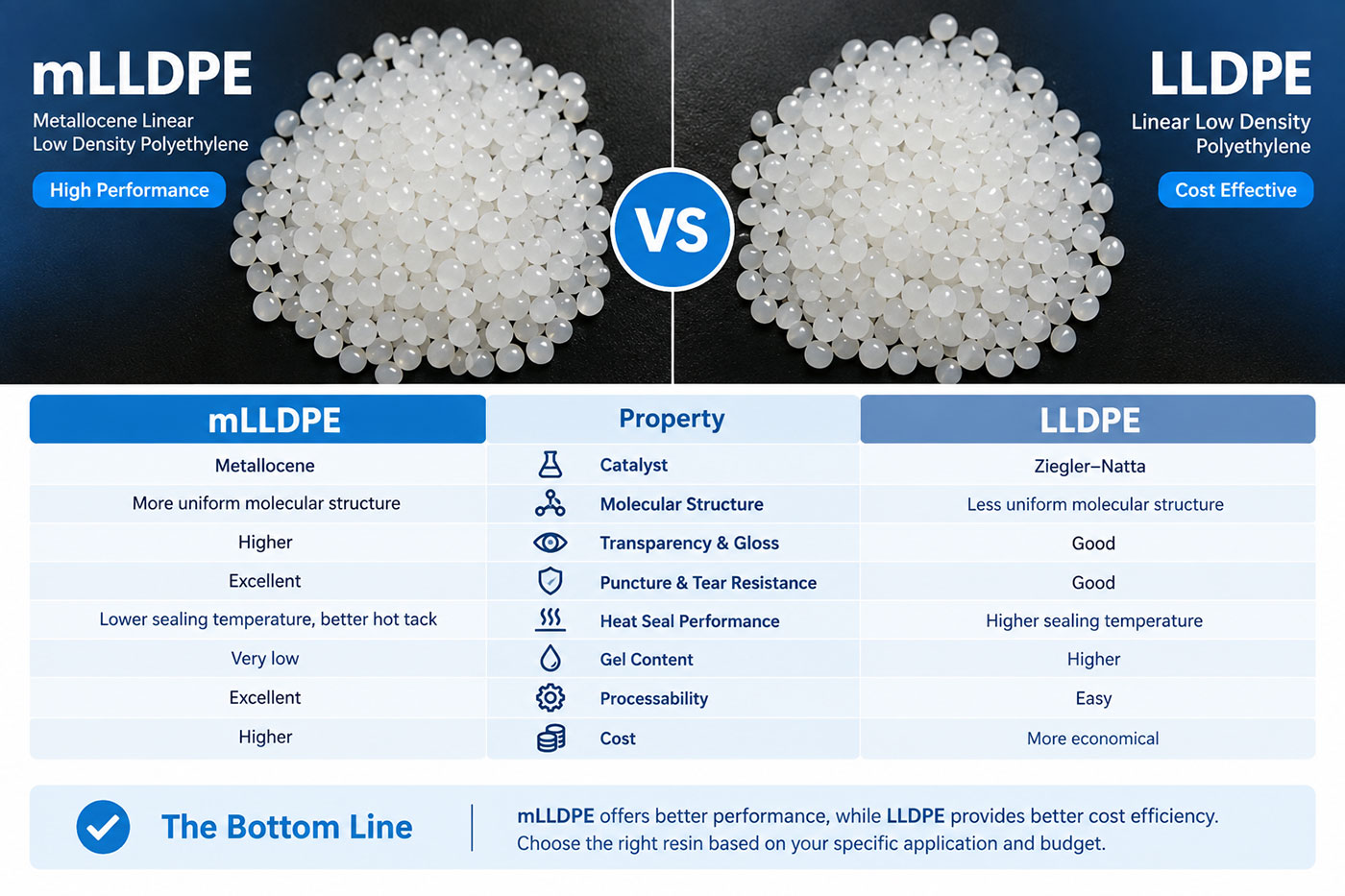
mLLDPE vs LLDPE
| Property | mLLDPE | LLDPE |
| Catalyst | Metallocene | Ziegler–Natta |
| Molecular structure | Highly uniform | Less uniform |
| Transparency | Excellent | Good |
| Gloss | High | Medium |
| Puncture resistance | Excellent | Good |
| Tear strength | Very high | Moderate |
| Heat seal performance | Outstanding | Good |
| Gel content | Very low | Higher |
| Processability | Stable | Easy |
| Cost | Higher | More economical |
The most important takeaway is that mLLDPE offers better performance, while LLDPE offers better cost efficiency. The performance gap comes primarily from polymerization technology.
LLDPE molecular structure
LLDPE contains polymer chains with varying lengths and branch distributions. This creates broader molecular weight distribution and less consistent crystallization.
mLLDPE molecular structure
Metallocene catalysts produce nearly identical active sites during polymerization. Every polymer chain grows in a much more controlled manner, resulting in:
Uniform short-chain branching
Narrow molecular weight distribution
Better crystallinity control
More consistent physical properties
The uniform structure explains why mLLDPE performs better in demanding film applications.
mlldpe vs LLDPE: Mechanical Properties
| Property | mLLDPE | LLDPE |
| Tensile strength | Higher | Standard |
| Elongation | Excellent | Excellent |
| Dart impact | Outstanding | Good |
| Puncture resistance | Superior | Moderate |
| Tear resistance | Higher | Good |
| Flex crack resistance | Better | Standard |
For heavy-duty packaging, mLLDPE can often achieve the same strength using thinner film gauges, reducing material consumption.
For Example: A pallet stretch film made with mLLDPE may reduce thickness from 23 μm to 20 μm while maintaining similar load stability, improving material efficiency.
>> Optical Properties: Clarity and Gloss
If product appearance matters, mLLDPE is usually the better option.
mLLDPE produces films with higher gloss, lower haze, better transparency, more premium shelf appearance.
This makes it popular for food packaging, frozen food bags, retail packaging, and consumer products.
>> Heat Sealing Performance
| Feature | mLLDPE | LLDPE |
| Seal initiation temperature | Lower | Higher |
| Hot tack | Better | Good |
| Seal strength | Stronger | Standard |
| Packaging speed | Faster | Moderate |
A lower sealing temperature helps converters:
Increase packaging speed
Reduce energy consumption
Improve sealing reliability
Lower reject rates
This is especially valuable for high-speed automatic packaging lines.
>> Processing Performance
LLDPE advantages
Wide processing window
Easy blown film extrusion
Stable bubble formation
Suitable for general-purpose production
mLLDPE advantages
Better bubble stability at high output
Lower gel formation
Improved film thickness uniformity
Better downgauging capability
mLLDPE vs LLDPE: Applicaitons
mLLDPE vs LLDPE: Cost
| Factor | mLLDPE | LLDPE |
| Resin price | Higher | Lower |
| Film thickness | Thinner possible | Standard |
| Mechanical performance | Higher | Good |
| Premium packaging | Excellent | Limited |
| Cost efficiency | High in performance applications | High in commodity products |
Which One Should You Choose: mLLDPE or LLDPE?
Choose LLDPE if your priority is:
Lowest material cost
Commodity packaging
Shopping bags
Agricultural film
General industrial film
Choose mLLDPE if you need:
Superior puncture resistance
Better transparency
Strong heat sealing
Premium food packaging
High-speed packaging lines
Thin yet durable films
For many converters, an optimal solution is blending mLLDPE with LLDPE, balancing performance and cost.
Can mLLDPE Replace LLDPE Completely?
Not necessarily.
Many manufacturers use blends such as:
| Blend ratio | Typical purpose |
| 20% mLLDPE + 80% LLDPE | Better sealability |
| 30% mLLDPE + 70% LLDPE | Improved toughness |
| 50% / 50% | Premium stretch film |
| 100% mLLDPE | High-performance packaging |
Blending allows converters to customize mechanical properties while controlling resin cost.
FAQs about mLLDPE VS LLDPE
1. Is mLLDPE stronger than LLDPE?
Yes. mLLDPE generally provides higher puncture resistance, tear strength, and impact performance because its polymer chains are more uniformly distributed through metallocene catalyst technology. This allows thinner films to achieve comparable or even better mechanical strength than conventional LLDPE.
2. What does the “m”in mLLDPE stand for?
The “m” stands for metallocene, referring to the catalyst system used during polymerization. Metallocene catalysts create a more uniform molecular structure than traditional Ziegler–Natta catalysts, resulting in improved optical and mechanical properties.
3. Is mLLDPE food safe?
Yes. Many mLLDPE grades are manufactured to comply with FDA, EU, and other food-contact regulations. However, buyers should always verify the specific resin grade and obtain the supplier’s food-contact declaration before use.
4. Which has better transparency, mLLDPE or LLDPE?
mLLDPE offers noticeably better clarity and gloss. Its lower haze makes it the preferred choice for retail food packaging, frozen food bags, and premium consumer packaging where product visibility is important.
5. Why is mLLDPE more expensive?
Its production requires advanced metallocene catalyst technology and tighter manufacturing control. While the resin price is higher, converters often offset the cost through downgauging and improved packaging efficiency.
6. Can mLLDPE be blended with LLDPE?
Absolutely. Blending is common in blown film production because it combines the excellent processability and lower cost of LLDPE with the enhanced strength and sealability of mLLDPE.
7. Is mLLDPE or LLDPE better for stretch film?
For high-performance pallet stretch film, mLLDPE is usually preferred because of its superior puncture resistance, load retention, and elongation. Standard LLDPE remains suitable for general-purpose stretch wrap applications.
8. Are mLLDPE and LLDPE recyclable?
Yes. Both mLLDPE and LLDPE belong to the polyethylene family and are recyclable in PE recycling streams, provided they are collected and processed appropriately according to local recycling systems.
9. What industries commonly use mLLDPE?
Major industries include food packaging, medical packaging, logistics, hygiene products, frozen food, industrial stretch hood film, and premium flexible packaging where higher performance is required.
10. How do I choose between mLLDPE and LLDPE?
Consider the final application, required film thickness, sealing performance, transparency, and total production cost. Commodity products typically favor LLDPE, while premium packaging usually benefits from mLLDPE.